Salt March & Civil Disobedience
Defying the salt tax, uniting millions in peaceful protest.
📜About This Movement
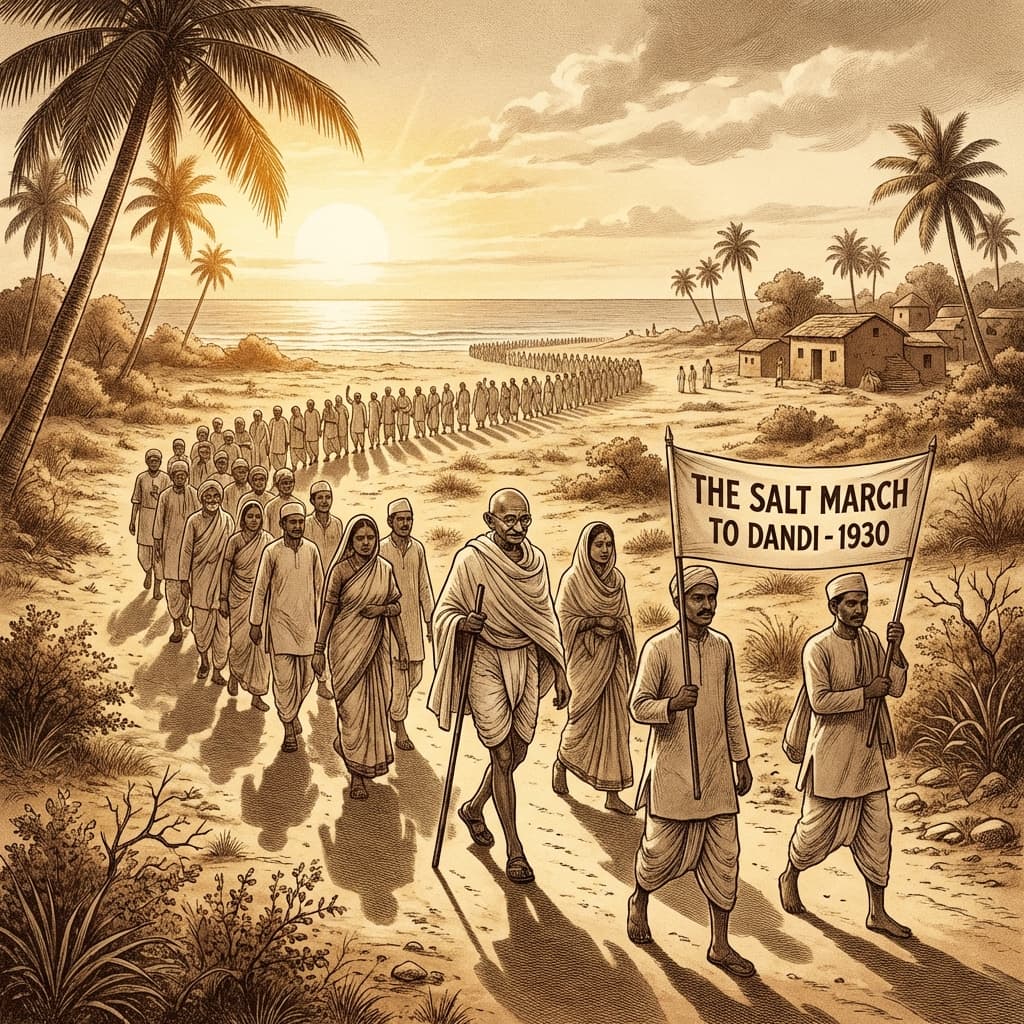
The Salt March, also known as the Dandi March or Salt Satyagraha, was a pivotal act of non-violent civil disobedience led by Mahatma Gandhi. Starting on March 12, 1930, Gandhi and 78 followers marched 240 miles from Sabarmati Ashram to the coastal village of Dandi to produce salt from seawater, directly defying British salt laws.
The British salt tax, which made it illegal for Indians to produce or sell salt independently, was seen as a symbol of colonial exploitation affecting every Indian, regardless of caste, creed, or economic status. Gandhi's choice of salt as the focus of civil disobedience was a masterstroke of political strategy.
The 24-day march captured the attention of the world. On April 6, 1930, Gandhi picked up a handful of salt at Dandi, symbolically breaking British law. This simple act inspired millions across India to start making their own salt and boycotting British products.
👥Key Leaders
📅Key Events
Beginning of march from Sabarmati (March 12, 1930)
Arrival at Dandi (April 5, 1930)
Gandhi breaks salt law (April 6, 1930)
Mass civil disobedience across India
Dharasana Satyagraha (May 21, 1930)
⭐Historical Significance
Demonstrated the power of symbolic protest and gained international attention for India's freedom struggle.
"Freedom is not given, it is taken."
— Netaji Subhas Chandra Bose
🇮🇳 Jai Hind 🇮🇳